Jul 5, 2008

Women Scavengers From India Walk The Ramp In New York

Usha Chomar is just one of the 3, 40,000 toilet cleaners in India. Born in deprivation, living in neglect but with a for upliftment. This is her story and many like her.

The word 'scavenger' has two different connotations. The first - Any animal that feeds on refuse and other decaying organic matter. And the second - Someone who collects things that have been discarded by others. It is sadly the second that is the kismet of many women (and kids) in India. Coming from the least economically privileged part of India's society they grow up with the sobriquet 'untouchables'. It is as damning for them as it is for the race which calls itself humans.

But this week some 36 of such women made there way from the bylanes of India to the ramps of New York. They sashayed down the catwalk alongside professional models in a display of recognition and respect courtesy the United Nations. The 36 women are special invitees at the conference to mark the UN's International Year of Sanitation. The special fashion show, Mission Sanitation was part of the U.N Program. The women walked the ramp with models who wore some of the clothes stitched by these workers.

For 36 year old Usha Chomar this was a memorable experience. Though she gave up scavenging three years ago, the memories of her own personal struggle are fresh.

"I have always done the work of scavenging and have faced humiliation all my life."

But with the offbeat 'recognition' given to her by the U.N, she felt finally respected...and like a human. Usha feels that if she could turn around her life so can others of her ilk.

"I tell all scavenging women that it is not impossible for them to change their lives and command just as much respect as any other human being."

Recalling her experiences since the age of seven, experiences which would make most of us cringe; she harks back to the days when she carried human excreta in buckets on her head. With the arrival of the rains the excreta would come down on her head and her body. She used to get vomiting, nausea, pain in the stomach and never felt like eating anything. But her work managed to feed her family of four.

Her life changed for the better when Mr. Bindeshwar Pathak, the head of sanitation specialists Sulabh International, an Indian Non-Governmental Organization (NGO) visited the locality. Bindeshwar Pathak gave them a chance to forego their past and start a new life of purpose. He established Nai Disha (meaning ‘New Direction’), a branch of Sulabh International, in Alwar which became the centre for the production of pickles, noodles and other eatables. This gave them a modicum of financial security and more importantly removed them from a demeaning occupation.

The change in there lives exemplifies also the changes in Indian society. After years of isolation, India's socially marginalized classes are being brought back into the mainstream. Governmental legislations coupled with pioneering work done by NGO's like Sulabh International is furthering the change. It is time we reclaimed the word - human

Jul 3, 2008

A Top Business Graduate Peddles A Dream On A Hand Cart

After graduating from India's top business school, this unique individual returns to his roots to fulfill a dream of making his home state the vegetable hub of India.

Indian Institute Of Management is one of the most elitist institutes in the world, comparable to the best anywhere. Churning out IQ blessed business graduates every year, who go on to occupy the top echelons of the corporate stratosphere. Kaushalendra could have easily chosen this as his destiny and nobody would have begrudged him that. An IIM graduate of the 1997 batch, he chose a different road to follow. The road lead to his home state of Bihar, a state blessed with a bounty of resources but cursed with under-development and mismanagement.

His mission - to make Bihar the vegetable hub of India. From a white collar job to the dust and grime of the rural hinterland, his journey with a pushcart is of one single minded purpose.

Kaushalendra says,

"I am here to do something. It was my childhood dream to contribute to the development of rural Bihar. I have opted to make vegetables the new brand of Bihar."

He is fondly called as the 'MBA sabzivallah’, literal for MBA vegetable vendor. Here is the story of this remarkable social hero.


It was 10 years ago that Kaushalendra started his 'enterprise'. Hailing from a farmer family, the roots of his thoughts and motivation originated from the state of affairs in rural Bihar. With a business degree from the prestigious IIM, Ahmedabad he started collating grassroots knowledge through extensive research and fieldwork. He met farmers and studied their cultivation methods.

In India, vegetable distribution is a complicated chain of processes. It finally culminates at the hands of the local vegetable vendors who sell the vegetables and fruits from manual push-carts made up of cycle wheels and a wooded platform. Often rickety at best, the push-cart system of vegetable distribution has existed for decades. This is where Kaushalendra focused his attention.

Drawing upon a project he had initiated early in his career to develop a push-cart capable of taking heavy loads (up to 450 pounds); he launched his 'line' of push-carts under a brand name. His pushcart is made of fiber with an attached weighing machine, is ice cooled to keep vegetables fresh for up to five days. He plans to take Samridhi, launched by his NGO Kaushalya Foundation, across the country and abroad within five years.

Under his business model, vegetables are priced slightly lower than those sold by other vendors. To further synthesize demand and supply, his organization has tied up with 250 vegetable growers in different villages around the region. He has also tied up with the Agriculture Training and Management Agency (ATMA) to take his dream to vegetable producers in different parts of state.

It is his belief that Bihar has a unique potential to harvest and profit from the untapped potential of its natural resources. If marketed properly, vegetable growers and consequently the entire state will gain from the nature's bounty which the river Ganges provides.

It is difficult to imagine this bespectacled IIM graduate pushing a hand-cart and promoting a cause which many of his peers and perhaps a progressive nation on the warpath of industrialization gave up long ago. But for the farmers in Bihar, the success of his venture could again bring renewed respect for an occupation which literally brings the food to our tables.

*According to a survey published by the prestigious London-based weekly Economist's "Intelligence Unit". IIM Ahmedabad has been ranked 64th in the list of the Top100 Business Schools in the world. Only four other Asian schools figure in it. Kellogg School of Management of Northwestern University, U.S was at the top.

Jun 18, 2008

Stanford Graduates Bring An Idea And Rays Of Light For Rural India

Rural India is the new developmental marketplace as some new age entrepreneurs fuelled by venture funds take it upon themselves to shed some light on the India that still lives on without electricity.


My father's oft repeated story that he learnt his alphabets by the light of a kerosene lamp has become a home grown cliché. But like most, it is a true cliché. India has come a long way since then because I am writing this article on a word processor on a computer.

Today, his family may have outgrown his own cliché, but this is daily truth for many parts of rural India. 60 per cent of rural households still make do without electricity. We as the modern child take power and its supply for granted. This is the dichotomy of 21st century India. A country which ignites a thousand tonnes of propellant to launch a self made rocket into space cannot ignite light in some parts of its land.

There are two pressing crises to deal with today in rural India. The first is of course electricity and the second is supply of clean drinking water. The first is perhaps more paramount because without it the second might not flow. It is not that India is apathetic to this cause for rural development because initiatives continue to be taken to fill the void between rural and urban India. The Electricity Act 2003, which allows for the first time in India a private utility to produce and distribute power, provides a glimmer of hope not only for the country but more so for the rural areas. The government is pushing the cart and now gradually private enterprise has come in to lend a hand. Whether as philanthropic initiatives or as a socio economic experiment, change is in the air.

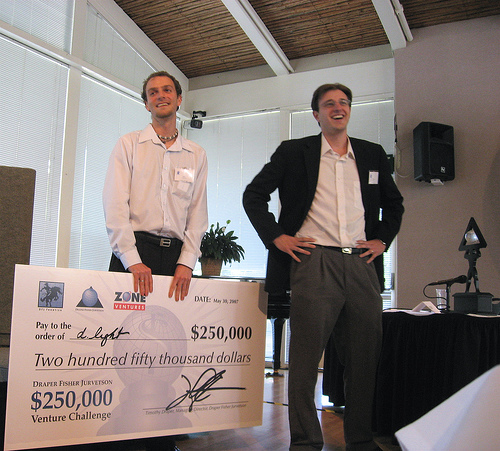
One such has come from faraway America. A start up company founded by graduates of Stanford Business School, D.Light Design aims to put in its bit to resolve the problem and earn a bit along the way. As a source they have used solar energy, something which is available in India all year round. The means is called Nova Light. It is simply a LED (Light Emitting Diode) based lamp that D.Light says will run for 40 hours on a single solar charge.

D.Light plans to sell the light for $15 to $30; the higher price includes both the solar charging panel and an AC charger. The men behind this unique quasi-business initiative are Ned Tozun (President of D.Light), Sam Goldman and Xianyi Wu. The three classmates believe that they can make an impact and create a profitable business out of it. So far they have raised $1.6 million in convertible notes from venture capital firms Draper Fisher Jurvetson, Garage Technology Ventures, Nexus India Capital and Indian firm, Mahindra and Mahindra. Enough to fund their prototypes and road testing in the dust bowls of India's rural heartlands.

Bill Reichert, managing director at Garage Technology Ventures believed the trio had a wining formula when he decided to invest in them. He says.

"If you want to light up the world, you've got to offer a solution that fits the needs of the people you're selling to."

The genesis of the idea happened in Ned Tozun's mind back in Stanford when he took a class at the Stanford Design School called "Design for Extreme Affordability." The class was full, but Tozun kept showing up anyway. Eventually, the professor let him join the class, which focused on rapid development of prototypes. Tozun followed up with the same persistence he displayed at Stanford. His company has brought out three models or versions based on his LED design.

The Comet is similar to the Nova but is stripped down. It might sell for $18 to $16. The Vega, is a compact fluorescent designed for families who live in areas where electricity is sporadic. The Vega will sell for $10 to $16. To cater to the lowest denominator of the poor in rural India, Asia and Africa Tozun's company realizes the importance of keeping costs low.

People who earn a wage of $1 a day would find it prohibitively difficult to earn and save the double digit dollar amounts. As a first step, D.Light is manufacturing the units in low cost labor area of Shenzhen, China. D.Light is also partnering a nonprofit group in India which plans to sell one version of the LED lights for just $1 apiece to Dalit families (formerly called the "untouchable" caste) in the state of Karnataka. Donations will be sought to cover the remaining costs.

India's rural development will have to use such innovative solutions to bridge the cost and development divide. A lot of similar companies to D.Light are experimenting with alternative sources of energy like biomass, ethanol and of course solar energy.

The solutions will not only address the power issue but the effects of illumination will also cancel out the over dependence of rural India on kerosene. A fuel which has been traditionally used not only in India but also in Africa, is dimly lit, spreads noxious fumes and is an environmental hazard. It is estimated that kerosene lamps kill or maim millions of children per year, and are a leading cause of indoor air pollution. Over a five-year period, one kerosene lamp releases one ton of CO2 into the air (equivalent to driving a car from San Francisco to NYC).

President Ned Tozun proclaims,

"Our mission is to eradicate the use of kerosene. People leave the kerosene lantern on low all night long as a kind of night light, and they wake up and cough black soot."

It could be a vision statement for a company which hopes to be a frontrunner amongst the rural vanguards. If their efforts succeed, it could spell a new paradigm shift for companies. Socio-economic development could become a new thrust area for new age entrepreneurs and businesses. Ultimately, light might arrive at all the doorsteps of those living in the darkness of rural Africa and Asia.

Also, posted by me on DigitalJournal.com